
If you want the few books that matter without learning the hobby
Are old comics actually worth anything?
Most boxes are mostly common books — but a few specific issues carry the value, and you don't need to learn comics to find them. Here's the fast way to check a box and sort it.
Updated June 18, 2026
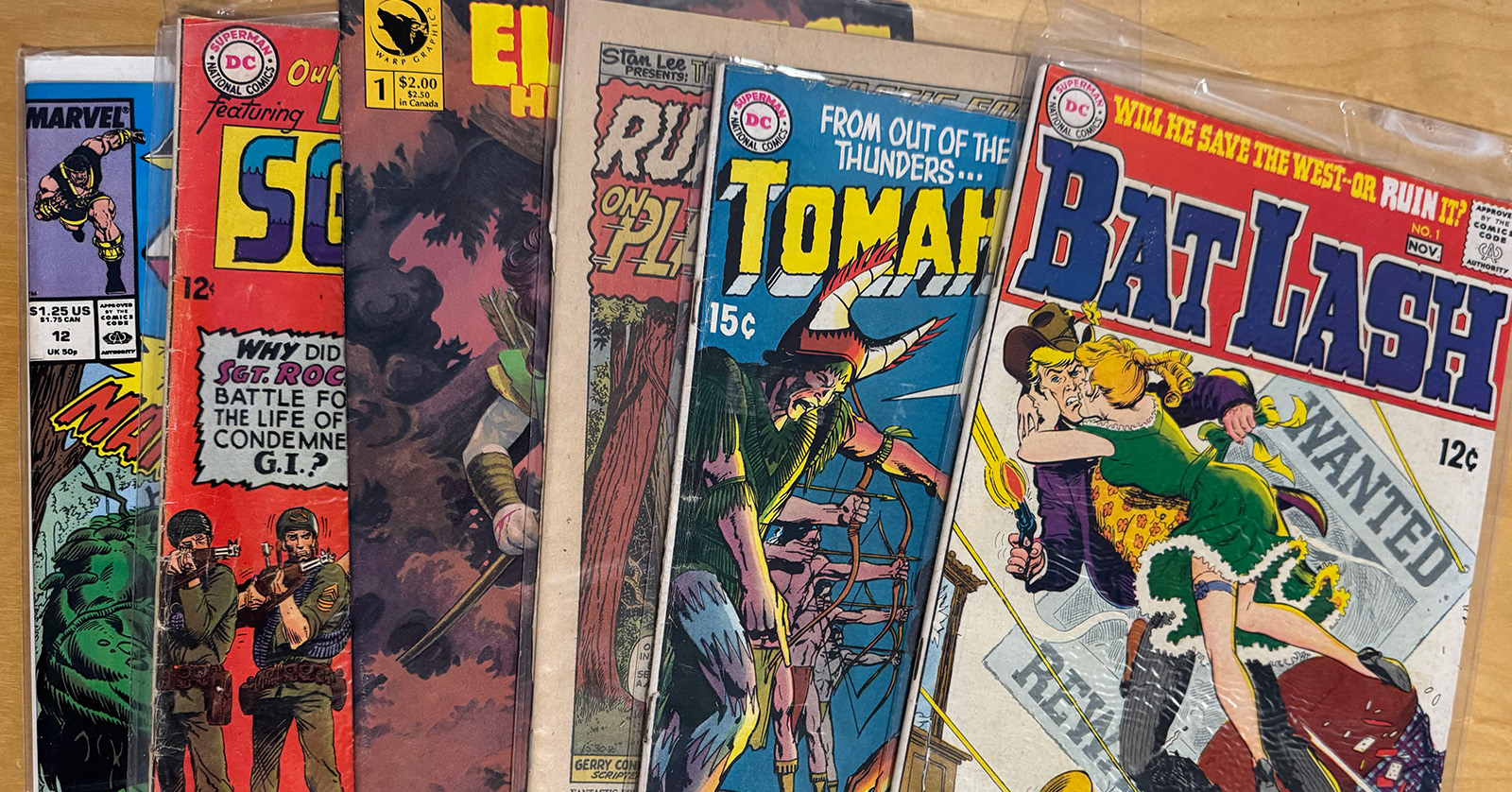
Most of a box is usually common books — that’s the honest part. But a few specific issues can carry most of the value, and you don’t need to learn comics to find them. There’s treasure hiding in that box, and there’s probably a lot of ordinary paper too. The only way to tell them apart is one book at a time — and that’s faster than it sounds.
Check a box in an afternoon
You don’t need to memorize character histories or learn collector terms. The method is three steps — Pick. Snap. Sort.
- Pick — pull one comic from the box. Leave it in its plastic sleeve if it has one; no need to take it out.
- Snap — point your phone at the cover. Comic Scry matches the art against the volunteer-run Grand Comics Database (which we credit and donate to) and shows the current asking prices for the book — a market signal to help you sort, not a sold price or appraisal.
- Sort — drop it into keep, sell, or bulk.
That’s the whole job. Your first 5 scans are free, with no account and no payment; after that it’s $19.99 once for 500 scans, never a subscription.
Have hundreds, not one box? Same method, just in batches. You’re separating the few books that matter from the many that don’t — not appraising every one.
Why old doesn’t mean valuable
People assume age and value move together. They don’t. A comic from 1992 can be worth a couple of dollars, while a scarcer older issue can be worth thousands — and plenty of 1960s and ’70s books are worth very little too. Age by itself is a weak hint.
Here’s why most boxes aren’t a windfall: from the late 1970s into the 1990s, comics were printed in enormous numbers — and that’s exactly when people started saving them because they expected them to become valuable. So the market is flooded with books from that era in nice condition. High supply plus careful preservation equals low price. The very thing that was supposed to make these books valuable — everyone keeping them in plastic — is what keeps them cheap.
The older books that do carry real value are the opposite story: printed before anyone treated comics as collectible, read and thrown away, so few clean copies survive.
What actually makes one worth more
A few plain things:
- First appearances. The issue where a major character shows up for the first time is the one most likely to carry real value — and the easiest to miss. The app flags these, so you don’t have to know them. Most boxes have none; some have one or two.
- Condition. A clean, flat copy is worth more than the same book with creases, tape, or stains — sometimes much more. Group the crisp ones and handle them by the edges.
- Scarcity. How many copies still exist in decent shape. It’s why some old books are cheap (millions survive) and a few are valuable (almost none do).
If a book is a first appearance, clean, and genuinely hard to find, that’s the rare one worth slowing down for. Most miss on all three — and that’s fine. The goal is simply to not miss the one that doesn’t.
The trap that fools almost everyone
Before you get excited about a famous cover: the most valuable comics are also the most reprinted. The same iconic cover often exists as a valuable original and a cheap later reprint, and to a non-collector they can look nearly identical. Don’t assume a famous-looking book is the original until the details confirm it. (There’s a whole guide on this: how to tell a reprint from an original.)
Start with one cover
You don’t have to commit to anything to find out what’s in the box. Pick the book on top, snap the cover, and sort it — then keep going if it helps. The point isn’t to judge the collection or hope for a fortune; it’s to make a calm, informed call about what deserves a closer look and what can stay in the bulk pile. One cover at a time, and now you know how.
Common questions
- Can I trust the value range, or is it just a guess?
- It's a range of what people are currently asking for the same book on eBay — a market signal, not a sold price or a formal appraisal. Asking prices usually run higher than what books finally sell for, so treat it as a starting point and a ceiling — condition and the exact edition move the real number.
- If a shop offers less than the app's range, am I getting lowballed?
- Not necessarily. The range reflects recent sales; a shop pays below that because they need to resell at a profit. Knowing the range just means you can tell a fair offer from a lowball before you accept.
- Where do I actually sell the books worth keeping?
- Standout single books do best sold individually — a dealer, an auction, or a marketplace listing. Common books move as bulk lots. The estate-selling guide walks through where each pile goes.
- Will it read a faded, taped, torn, or bagged cover?
- Usually yes. It reads the cover art, and you can scan right through a plastic sleeve. Very damaged or obscured covers are harder — wipe off dust and try again, or confirm a tricky one with a comic shop.
- What if it can't identify a book?
- Some books come back as no match, or with a couple of possible editions — that's normal for obscure or heavily reprinted issues. Pick the closest match, or set the book aside for a shop. It does not mean the book is rare or worthless.
- Do I need an account or to pay before I start?
- No account, no payment to start. Your first 5 scans are free; after that it's a one-time $19.99 for 500 scans, never a subscription.
- How long does a whole box take, and what does 500 scans cover?
- A typical box is an afternoon. 500 lifetime scans covers most collections, including large ones — the $19.99 is one-time, so there's no clock running.
- Does it work on Archie, Disney, manga, and other non-superhero comics?
- Yes — it isn't limited to superheroes. A few very niche or non-US books may come back without a match, but most mainstream titles are covered.
- Does Comic Scry buy my comics?
- No. It identifies and values books to help you sort and decide; selling is up to you, wherever you choose to do it.